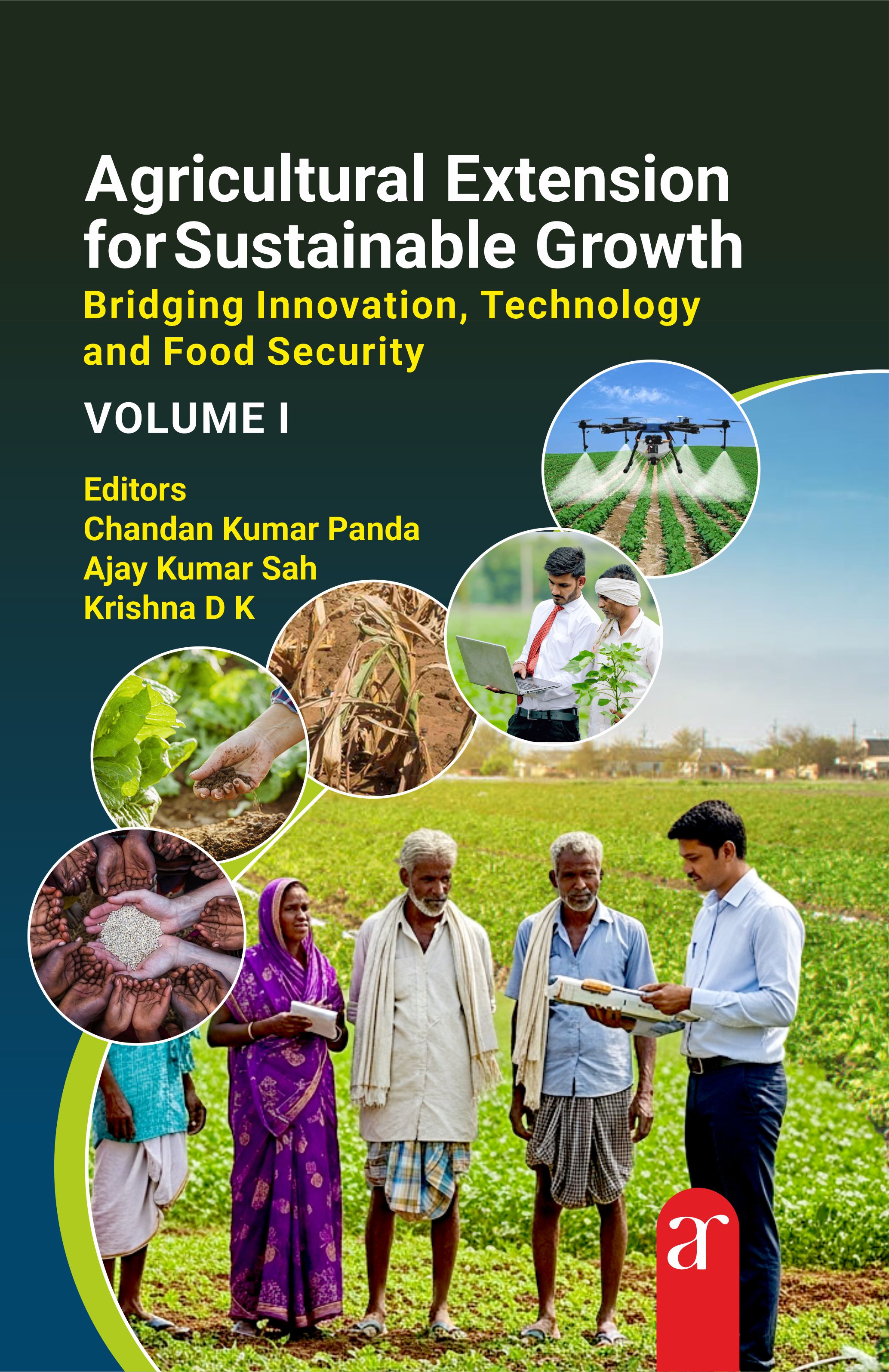
Agricultural Extension For Sustainable Growth: Bridging Innovation, Technology And Food Security (volume 2)
Ebook
ISBN: 9789349045842
Chapter: Chapter 13: Exploring The Opportunities Of Market Access And Value Chains Of Millets In India With Specific Emphasis On Bihar
Chapter No.: 13Contributors:
This chapter explores the value chain dynamics of millets in India, with a focus on their production, processing, and distribution. Introduced by Michael E. Porter in 1985, the value chain framework provides a structured approach to analyze the interconnected stages in millet cultivation, processing, and consumption. India, the largest producer of millets globally, accounts for a significant portion of millet production, with Rajasthan contributing 87% of Bajra cultivation, Maharashtra 75% of Sorghum, and, Karnataka 54% of Ragi & 32% of Bajra. Despite its potential, Bihar’s share in national millet output remains minimal, with contributions of 0.03% for Jowar, 0.03% for Bajra, 0.11% for Ragi, and 0.34% for small millets in 2021–22. The millet value chain includes primary activities such as input supply, production, processing, marketing, and distribution, as well as support activities like infrastructure, technology, and procurement. Major challenges include limited seed availability, inadequate infrastructure, and weak procurement networks. Case studies from Bihar and Chhattisgarh highlight initiatives such as the Bihar Centre of Excellence for Millets Value Chains, which engaged 1,194 farmers and demonstrated sustainable practices, and India’s largest millet processing unit in Chhattisgarh, with a capacity of 10–12 thousand tonnes annually, supporting 29,000 farmers. The potential for millet-based value-added products that serve both urban and export markets is demonstrated by creative business endeavors such as Online Cake Bhejo in Bihar. Additionally, with yearly supplemental incomes ranging from ₹30,000 to ₹50,000, women-led millet farming initiatives in Bihar have improved nutrition and financial independence. According to the chapter’s conclusion, challenges can be overcome and millets’ potential as a pillar of sustainable agriculture, climate resilience, and nutrition security can be unlocked by fortifying the millet value chain through technological developments, better infrastructure, and focused policies.
Keywords: Climate Resilience; Green Revolution; Nutrition Security; Organic Farming; Porter’s Value Chain Model; Sustainable Agriculture; Value Chain Analysis; Value-Added Products.
List of All Chapters
1 - Chapter 1: Nutrition Smart Agricult...
2 - Chapter 2: Crafting Extension Strat...
3 - Chapter 3: Agricultural Extension S...
4 - Chapter 4: Mushroom: An Excellent S...
5 - Chapter 5: Community Based Approach...
6 - Chapter 6: Strengthening Food Secur...
7 - Chapter 7: Food Security And Nutrit...
8 - Chapter 8: Food Security And Nutrit...
9 - Chapter 9: Role Of Good Agriculture...
10 - Chapter 10: Strengthening Agricultu...
11 - Chapter 11: Fostering Sustainable A...
12 - Chapter 12: Role Of Traditional Med...
13 - Chapter 13: Exploring The Opportuni...
14 - Chapter 14: Impact Of Climate Chang...
15 - Chapter 15: Climate Change And Indi...
16 - Chapter 16: Agricultural Extension ...
17 - Chapter 17: Innovative Extension Sy...
Book Details
Agricultural Extension For Sustainable Growth: Bridging Innovation, Technology And Food Security (volume 2) NEW
REFERENCE BOOK
0
0
0
AMERICAN ROYAL (6X9)
350 Gms
All Rights Reserved
M/s AGROBIOS RESEARCH
PG STUDENTS | SCIENTISTS AND RESEARCHERS |
Books with Same Authors
Books with Similar Subjects